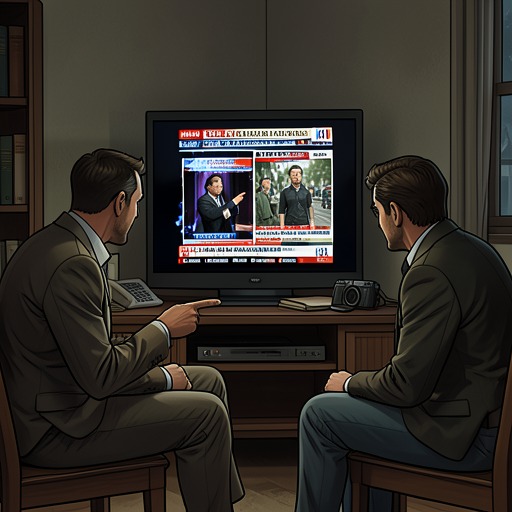
The television set in the cabin
The Cabin at the End of the WorldThe television set in the cabin is at once an ordinary household appliance, a point of conflict among captors and captives, and the screen through which the group’s apocalyptic convictions acquire apparent public proof. Its programming moves from Wen’s familiar cartoon to rolling disaster coverage, while who controls the remote—and who can bear to watch—becomes part of the struggle inside the cabin.
A Household Object Under Siege
The flat-screen is mounted above the couch, where Redmond sits after the violence, dabbing his swollen nose and lips with a white kitchen towel. Its placement makes it a fixture of the room, but during the confinement it does not remain a neutral background object. The television’s volume is too loud for Eric, whose head is already overstressed by the grinding sound of broken glass. He asks several times for the volume to be lowered. Leonard seems to comply twice, lifting and pointing the remote, but the red volume bar never appears. His performance of cooperation leaves Eric listening to the same unwanted sound.
The remote becomes a small instrument of authority. Leonard can pretend to adjust the sound, switch the set off, restore it, pause a program, or redirect attention toward the news. These gestures are modest in physical scale, but their effect is immediate: the people in the cabin must either follow the images or contend with the person deciding what will appear. The screen’s domestic familiarity therefore sharpens, rather than softens, the coercion around it.
Wen’s Program and Divided Attention
Wen’s favorite show, Steven Universe, is playing above Redmond when Leonard is in the kitchen sweeping up broken glass. She has seen the episode before. In it, Steven and the Crystal Gems repeatedly dismantle a communications hub that Peridot has rebuilt; Pearl eventually admits that she kept rebuilding it because she loves merging with Garnet as Sardonyx. Wen watches and does not watch at once: one part of her imagines becoming Sardonyx and sweeping the intruders into the garbage with the character’s war hammer, while another attends to the adults’ words and movements and waits for a signal from either of her dads.
The episode’s cycle of rebuilding and demolition gives Wen a story to inhabit while she monitors danger in the room. Her engagement with the show is neither simple distraction nor uncomplicated comfort. It permits an inward fantasy of resistance, even as her other attention remains trained on what the captors might do. When Leonard later turns the set off and tosses the remote onto the couch, he apologizes to Wen and says he may put it back on later. The interruption makes control over her familiar program visible as one more decision the adults are making for her.
After Redmond’s death, Leonard finds the remote among the couch cushions and restores Steven Universe. Eric recognizes the episode but cannot tell whether it is the one that had been playing earlier or another showing; his concussion has left him uncertain of how much time has passed. Wen turns toward the returning program, standing unnaturally straight, with her thumbs pressed into her fists at her mouth. The show’s return offers no reset for the cabin: the people and violence remain where they were, even as the screen resumes its familiar images.
From Cartoon to Breaking News
Leonard next pauses the cartoon, freezing Steven with a triumphant fist raised, and says he will change the channel only briefly. He checks his watch and insists that the others watch the television for what is coming. The screen first offers not catastrophe but ordinary broadcast filler: a midafternoon business program gives way to a supplemental health-coverage commercial for seniors, followed by advertisements and a loud political-program promotion. The delay stretches the room’s attention before the news supplies the images Leonard expects.
The first major report concerns a magnitude 7.9 earthquake in the Aleutian Islands, which had struck more than four hours earlier. The report describes tsunami advisories along the Pacific coast and a strongest warning for Hawaii, where north-facing coastlines are under mandatory evacuation orders. A spokesperson explains that detection buoys indicate a wave fifteen to twenty feet high moving toward the islands. Footage from a resort on Kauai shows water overtaking a beach, empty pool, courtyard, cabanas, and lower-level rooms; other clips show boats, marinas, docks, and coastal roads overwhelmed. The spokesperson says early warnings allowed evacuations and that, at that point, no injuries or fatalities had been reported.
For Leonard and his companions, the broadcast is not merely news of a disaster. They have been waiting for something they believe was shown to them, and Leonard treats the reports as signs that their warning and demands have been vindicated. Yet the sequence retains uncertainty: Eric wonders whether the resort footage is live or recorded, while the screen’s rapid changes, commercial breaks, and rolling presentation give him no stable way to establish precisely what he is seeing. The television supplies striking images and specific figures, but the captives encounter them through the same channel Leonard controls.
The Screen as Evidence and Pressure
While the Hawaiian flooding is replayed, a broadcaster announces a second earthquake: magnitude 8.6, with an epicenter about seventy miles off Oregon in the Cascadia Subduction Zone. Leonard first erupts with relief and accusation, claiming the family could have stopped the catastrophe by making a sacrifice. He then corrects himself, saying that he means the group could have stopped it and that they failed together. The news has intensified his conviction, but it also exposes the strain in his explanation: responsibility shifts between the captives and the visitors even as he calls their fate shared.
The report gives the danger concrete scale. A seismologist suggests the Aleutian earthquake may have triggered the second quake, which lasted almost five minutes. Another scientist estimates that a tsunami could reach twenty to fifty feet, travel as a wave kilometers long, and leave coastal residents only minutes to escape. Because bluffs about fifty feet high might not be safe, the advice is to seek ground eighty to one hundred feet above sea level. The newscaster then announces that a tsunami has struck the Oregon shoreline and introduces footage from Cannon Beach. The broadcast’s accumulating details turn Leonard’s waiting into a demand that the others witness what he believes has been foretold.
The set does not settle the question of whether the visitors’ interpretation is true. It does make denial harder: information about earthquakes, warnings, and flooding arrives in the cabin alongside Leonard’s insistence that the events confirm their mission. News footage and coercive interpretation share the same screen, but they are not the same thing. The distinction matters because the family is being pressured to treat a public disaster as proof that a private act of violence was necessary.
Later Images and the Limits of Control
Later, Eric reaches for the television’s power button, which is hidden on the inside edge of the nearly invisible plastic frame and is only about half the size of his finger pad. A fly crawling in looping sideways eights on the lower corner of the screen guides his hand toward it. After a short delay, the display fills with rapidly changing images and an offscreen narrator: airport views, a hospital staffed by people in protective clothing, crowded sidewalks and markets, packed subways, and masked faces. Eric cannot focus on the barrage and backs away from the set, bumping into Andrew. He cannot recall deciding whether to turn it on and explains his action by referring to the fly.
After Leonard is killed, the television again carries breaking news, this time interrupting a program about bird flu with images of smoking airplane wrecks. The account moves among crashes in fields and wreckage in the ocean; one plane’s tail rises above the water while pieces of its fuselage float nearby. Eric, still holding Wen, stands back from the couch to see the screen more clearly, his paper-towel dressing hanging loosely from his head. The set’s succession of crises has become difficult to escape even after the person who controlled the room’s attention is gone.
Across these scenes, the television is both a conduit for reports about events beyond the cabin and a physical device whose operation is mediated by hands, remotes, volume, and a concealed button. Its images can support the visitors’ certainty without explaining the source or meaning of that certainty; they can also overwhelm Eric, interrupt Wen’s refuge in a familiar story, and hold the captives’ attention against their wishes. The appliance’s ordinary functions—playing a cartoon, changing channels, displaying news—become part of the siege’s machinery, while the succession of disasters on its screen keeps the distinction between witnessing catastrophe and accepting someone else’s account of it under pressure.